
Donna’s Story: “I Didn’t Survive to Be Basic”
June 5, 2026
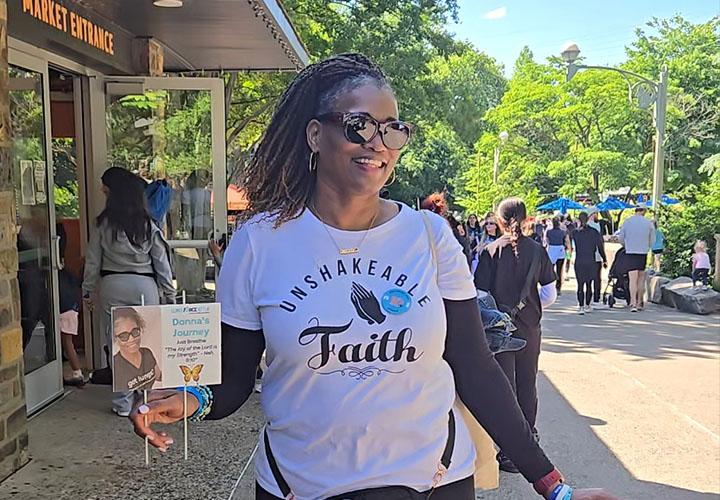
Donna Thompson is a 3-time survivor of early-stage, non-small cell lung cancer, thriving more than a decade since her first diagnosis. After 2 surgeries to remove portions of her right lung, she carries forward an experience that deepens her commitment to lung cancer awareness, mental health advocacy, and building supportive communities. Donna shares her story to inspire hope, reduce stigma, and elevate survivor voices. Her advocacy spans education, outreach, and research collaboration within the lung cancer community. She speaks at wellness and community events, using her experience to empower others navigating illness and recovery. Professionally, Donna is the director of Human Resources and a SHRM Certified HR leader, known for leading with empathy and practical insight, and supporting people through complex workplace challenges. She finds strength - literally and emotionally - through faith, fitness training, and time in nature. For her, movement is medicine, and advocacy is a calling rooted in compassion and resilience.
Donna remembers the exact moment everything changed. It was September 2015, and she went to the emergency room for something else entirely. Her blood sugar was dangerously high, and she wasn’t feeling right. They ran tests, monitored her, and sent her home. The next day, the ER doctor called her and said the radiologist saw a mass in her lung and that she should have it checked out right away.
At 45 years old, and having no smoking history, lung cancer wasn’t on her radar. It wasn’t on anyone else’s either.
“Everyone I talked to was like, ‘You’re too young. You’ve never smoked. This is probably not lung cancer.’”
But within 5 weeks, after scans, a biopsy, and what she still calls “the longest 5 weeks of my life,” Donna had her answer. It was lung cancer after all.
"The best possible situation”
Looking back, Donna sees the moments that led to her lung cancer diagnosis a little differently.
“I always say that was God getting my attention, whispering to me in the quiet, still moments," she said.
The tumor was stage 2 (II) and operable. In many ways, it was the best-case scenario for a diagnosis no one expected. Her surgical team moved quickly.
“She told me, ‘This is the best possible situation. It’s in a good location. We can take it out.’”
By the end of November, just 2 months after that ER visit, Donna had surgery, and for a moment, it felt like the worst might already be behind her.
When the plan changes
Initially, Donna was told she wouldn’t need chemotherapy. The surgery had been successful, her margins were clean, and everything pointed in the right direction.
Then the pathology report came back. It showed that her tumor was more complex than expected. It was an unusual form of adenocarcinoma that didn’t behave in typical ways. Her case was sent to multiple cancer centers, and the recommendation shifted.
“I remember my surgeon calling me herself,” Donna said. “She said, ‘I told you one thing, and now it’s changing, and I need to explain that to you.’”
A second opinion confirmed it: chemotherapy was recommended. Donna agreed, but her body had other plans.
When treatment becomes the crisis
“Every time I got chemo, I ended up in the ER,” she said. “Something was always going wrong.”
After just two treatments, it was clear that this wasn’t sustainable. Her oncologist made the call.
“He said, ‘Your body can’t handle this. We’re done.’”
It was a moment that carried both relief and uncertainty. The treatment meant to protect her was, instead, putting her in danger. And so, once again, Donna adjusted.
“I didn’t survive to be basic.”
In the months that followed, Donna made a decision that would shape everything that came next.
“I didn’t survive to be basic,” she said.
Instead, she poured herself into her health and started working with a trainer, changing her diet, and reclaiming a sense of control over her body.
“I got into the best shape of my life,” she said. “I came off medications. My A1C went back to normal. Everything changed.”
But the transformation wasn’t just physical. It was also about identity.
“The cancer gave me more than it took from me,” she said. “I learned who I am, how strong I can be, and what I really need in the world. I learned what and who are important to me. It put such a clear focus on what I want for my life.”
Finding community and belonging
Still, parts of the experience felt isolating.
“I kept meeting people, and they were all stage 4 (IV),” she said. “I felt like, am I even supposed to be here?”
She was grateful for her outcome, but that gratitude came with a quiet tension.
“I didn’t want to take up space in their groups,” she said. “But I still needed support too.”
And there was something else. “I didn’t see anyone who looked like me.”
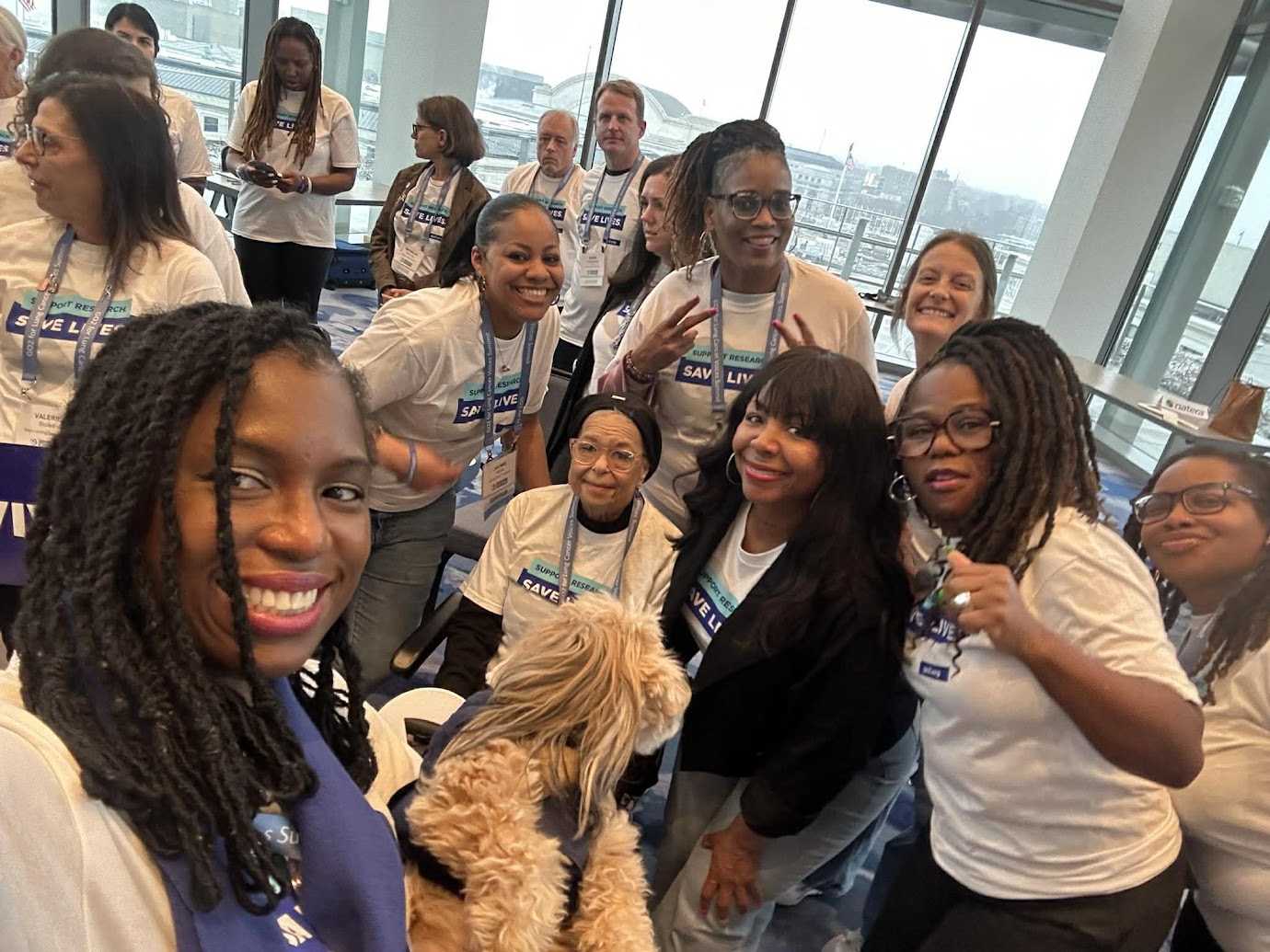
It wasn’t until years later, through social media connections, introductions, and small group conversations, that Donna found what she had been missing: a close-knit circle of Black women who truly understood her experience.
“We started meeting regularly, talking, and supporting each other,” she said. “There’s something about being with people who understand you completely without you having to explain that changes everything. They know what they did for me, and what we do for one another. Finally, I had community.”

A second diagnosis, and a different reality
For nearly 7 years, Donna focused on moving forward, rebuilding, and holding onto the belief that she had come through something and grown because of it.
Then, in 2022, everything shifted again. This time, it wasn’t a symptom that sent her back to treatment. It was a scan.
“My scans went from showing nothing to showing a tumor the same size as my first diagnosis,” she said. “I was just so shocked because I wasn’t expecting anything.”
As Donna began to piece together what had happened, the story became even more complicated. The tumor hadn’t appeared overnight. When her new care team reviewed her prior scans, they discovered that the growth had been visible as far back as 2018, but it had been missed.
The radiologist who originally read the scan had not flagged it, and even more concerning, it became clear that her oncologist had never reviewed the images directly.
“That was the moment for me,” Donna said. “I realized no one had really been looking out for me the way they should have. I felt like a number, and I’m a relationship person. This matters to me.”
It was a turning point, not just medically, but emotionally. What initially felt like a sudden recurrence became something harder to process. It was a missed opportunity for earlier intervention.
Another treatment crisis
This time, Donna’s treatment plan included a targeted therapy designed specifically for EGFR-positive lung cancer that would allow her to take a lower dose of chemo, which they hoped she would tolerate better. It felt like progress and a better path.
But after a second surgery, adjuvant chemo, and introducing the new treatment, her body began to struggle again in a different and even more frightening way, this time in response to the targeted therapy.
After multiple attempts to adjust the dosage, the new medicine ultimately led to kidney failure, a serious complication that forced yet another shift in her care and another redefinition of what “moving forward” would look like.
It was also the moment that changed how Donna understood her own story.
“I used to say that cancer gave me more than it took from me,” she said. “And I believed that until my kidneys failed. Recovering from that took nearly all I had. I’m still trying to fully move on from how traumatic that year was.”
“I also have to remind myself how remarkable it was that I overcame this,” she said. “My nephrologist said my recovery was miraculous, and it does feel like a total miracle now.”
Living in the in-between
Today, Donna is once again in a place that many people with lung cancer know all too well: waiting.
In July 2025, after recovering from kidney failure, her care team radiated 2 new spots. They chose radiation because it was the gentlest option for her. Recent scans have shown new nodules that Donna and her care team are just watching, for now.
“They’re watching them and trying to decide what to do next,” she said. “And with my treatment history, not every option feels like a good one.”
It’s not a crisis. But it’s not clarity, either, and Donna finds herself struggling with living in this place of uncertainty.
“I like to have a plan, and I like to know what we’re going to do. I’m finding it very hard for me to just wait and see.”
Still choosing more
Through her diagnosis, treatment, recurrence, and all the unexpected turns in between, Donna has held onto a simple mindset:
“I didn’t survive to be basic.”
It’s a phrase that stuck with her early on and has continued to shape how she moves through each new chapter. And for Donna, that means continuing to choose a full life, even in the unknown.
If you or someone you love has been diagnosed with lung cancer, know that you're not alone. Our HelpLine provides free, one-on-one support to people impacted by the disease. Call 1-800-298-2436 or email support@go2.org to connect. Our team is available Monday-Friday from 9 a.m.-5 p.m. ET/6 a.m.-2 p.m. PT.