
“I am a Zebra:” Mayya's Story
September 16, 2026

Before lung cancer, Mayya was used to having a plan for everything. As a high performing marketing executive in the video game industry, she managed multimillion-dollar campaigns, led large teams, and was interviewing for a major new leadership role when her life took an unexpected turn. At home, she and her husband were raising 2 young children and juggling the beautiful chaos that comes with life as a busy young family.
By all accounts, things were going well.
“I was essentially corporate Barbie,” Mayya said.
She was healthy, active, and the last person anyone would have expected to be diagnosed with lung cancer. But looking back, Mayya knew something wasn’t right.
Trusting herself

It started during her second pregnancy. Mayya wasn’t gaining weight the way she had during her first pregnancy. She constantly felt like she had to remind herself to eat and found herself raising concerns with her care team at appointment after appointment.
After her daughter was born, other symptoms followed. She was exhausted, but she had a newborn and a toddler. Of course she was exhausted. She lost the baby weight quickly, but everyone congratulated her for it.
Then came the cough. At first, that was easy to explain away too. Her family had endured the endless parade of illnesses familiar to many families with children in day care. But when everyone else recovered, Mayya didn’t. Her cough lingered, as did the fatigue and the general feeling that something was off.
When she sought medical care, her concerns were dismissed, and she was told it was likely allergies or a lingering infection. In fact, the first doctor barely listened to her, looking at the clock before she ever looked at Mayya. When Mayya asked for an X-ray, the doctor said she didn't need one. "It doesn't sound dry," the doctor said. "I haven't coughed yet," Mayya replied.
She walked to her car in the parking lot and called the office back immediately to make a new appointment with a different doctor. Then that appointment got canceled, so she drove straight to urgent care where she found a doctor who was finally willing to dig a little deeper.
An X-ray showed some cloudiness. It was not a clear answer, but it was something. Mayya was given antibiotics for possible pneumonia and sent home, but she didn't get better.
"I was feeling slightly worse every day," she remembered.
Then came Mother's Day. Mayya was sitting on the floor playing with her kids, exhausted, when she heard a sudden, clear, and urgent voice in her head: “If you don't go to urgent care right now, you're going to die.”
"It had to be my grandmother," she said. "She had a flair for the dramatics."
She turned to her husband. "I know it's Mother's Day, but I have to go."
At urgent care, the same doctor who had seen her earlier that week sent Mayya directly to the ER, worried she had a dangerous blood clot in her lungs known as a pulmonary embolism. Before going to the ER, she went home, breastfed the baby, left a stash of milk in the fridge, and said goodbye to her 3-year-old son, who asked how she'd get home.
"You guys will pick me up in a little bit," she told him.
At the ER, a CT scan brought unexpected news. There was no blood clot, but there was a mass in her chest.
"I knew in that moment it was cancer," Mayya says. "I knew."
The long road to a name
For weeks, the working assumption was lymphoma. Nobody brought up lung cancer because she was young, had no known risk factors, and her blood work was perfect.
She was admitted to the hospital where she had a bronchoscopy and got sent home. The interventional pulmonologist who did the procedure told her, “My job is to get you answers." The bronchoscopy came back inconclusive, but he was honest that something didn’t look right.
Then came a PET scan. Every lymph node from her neck to abdomen as well as her bones lit up. Still, the results pointed to lymphoma because her lung itself was barely glowing.
Following that, Mayya was matched with an oncologist at Duke Cancer Center. The coordinator on the phone mentioned access to clinical trials. “Trials?” Mayya thought. “I don't need trials for something as vanilla as lymphoma.”
She looked the doctor up. He was a thoracic oncologist. Her stomach dropped. She wondered whether perhaps he was moonlighting in hematology.
Mayya was at the beach with her family when she opened her test results. They reported stage 4 (IV), ALK-positive, non-small cell lung cancer (NSCLC). “Metastatic, metastatic, metastatic,” the word repeated down the page. No clean margins.
"That's how I found out," she said. "At the beach house, by myself, piecing it together."
A zebra in a world full of horses
There is a concept in medicine called Occam's Razor which states that when you hear hoofbeats, you should assume horses, not zebras. In other words, doctors are taught to look for the most likely explanation before considering something more rare. Mayya knows this, and she understands it. "But I am a zebra," she said. "And doctors are so used to looking for horses that when a zebra is standing right in front of them, they try to make it a horse."
At 38 years old, Mayya became part of a growing group of people who are reshaping what the world thinks lung cancer looks like. Young, healthy, active, and with no traditional risk factors, these people do not appear to doctors as “typical” lung cancer patients and often experience long delays in diagnosis because of it.
In other words, they are zebras.
A zebra among zebras
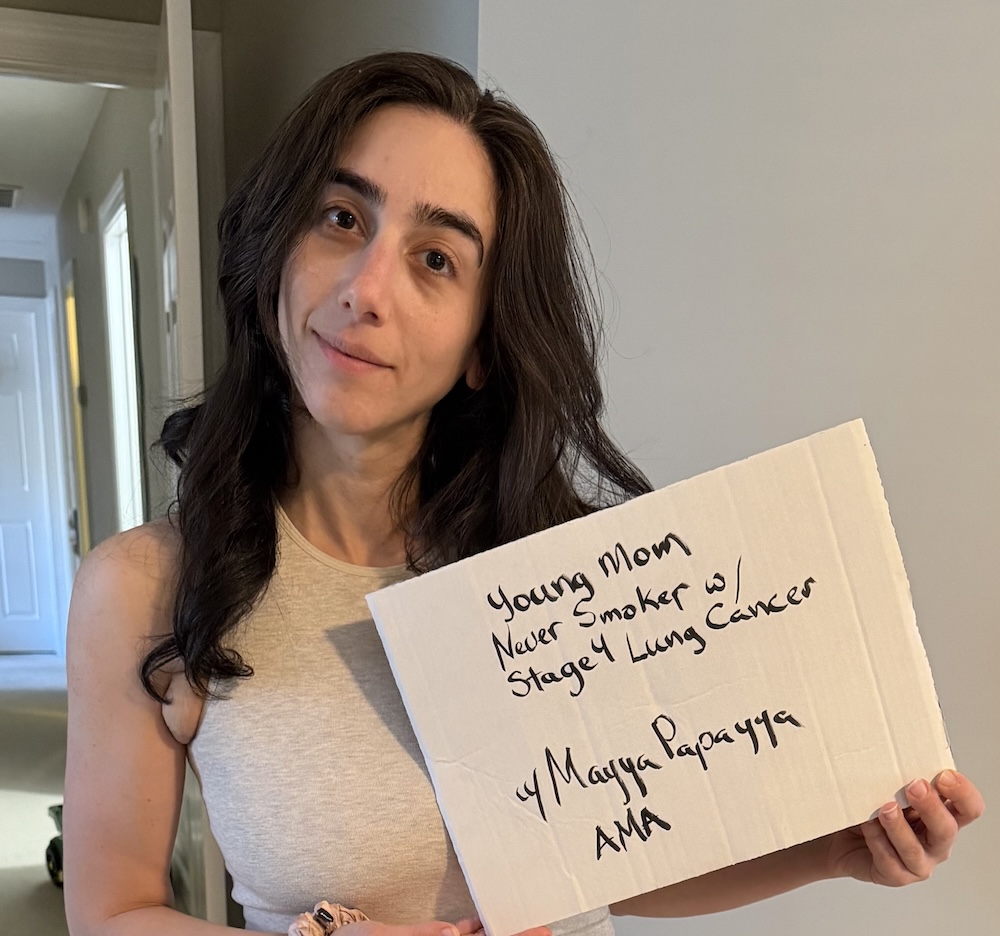
If being diagnosed with lung cancer at 38 made Mayya a zebra, her experience after diagnosis only reinforced the point.
She started Lobrena (lorlatinib), a targeted therapy for ALK-positive lung cancer. Her response was extraordinary. By her first scan, nearly all evidence of disease in her bones and lymph nodes had disappeared. Her doctor had never seen anything like it.
She was told that she was lucky to have this genetic type, and she and her care team hoped she would be one of the large number of ALK-positive patients having many years of progression-free survival on the drug.
However, 8 months later, the cancer progressed. And once again, Mayya found herself outside the expected path.
"I call myself the ghost of Christmas future, walking around rattling chains in ALK communities," she said with a laugh. "They say the median survival on lorlatinib is 7 years. I made it 8 months. I represent a possibility that nobody wants to think about."
Being someone whose cancer progresses quickly on a treatment that works for most others carries its own weight. Mayya has talked to others in the same position and found something unexpected: shame.
"There's almost an embarrassment in it," she said. "You see those graphs showing how well people do, but then you fall off at the 2% mark. Nobody likes to talk about those people. Unfortunately, a third of people on the drug will have an experience like mine. We have to understand our experiences too.”
Mayya is now on a combination regimen of chemotherapy, lorlatinib at a reduced dose, and Avastin (bevacizumab), a plan developed in collaboration between her primary oncologist at Duke and a second-opinion team at Dana-Farber Cancer Institute, including 1 of the leading ALK researchers in the country.
"Between the 2 of them, they came up with a plan that I don't think either would have come up with on their own," she said. “They’re a great team.”
Who gets your best 8 hours?
Life changed for Mayya in large and small ways after her diagnosis. Despite being a successful professional and her family’s bread winner, she made the decision to step back from work and go on disability. It wasn't a defeat. It was a choice.
"Statistically speaking, the best I was going to feel was right after diagnosis," she said. "My doctors aren't trying to cure me; they are managing a downhill slide. And I realized that I was giving the best 8 hours of my day during the best part of my life to my CEO. I had to ask myself, who did I actually want to be giving those hours to?"
The answer was her kids, her husband, and her mom, who now lives with them. Her family, whom she had always prioritized, became her full focus. They plan trips, go to swim lessons and ballet recitals, and squeeze adventures into the windows between her every-3-week infusions on the days when she feels well enough to go.
Her biggest fear is not her own death. It is the crater she would leave behind. She worries for her children, who were 3 years old and 8 months old when she was diagnosed; her mother, who has already buried a husband and her own mother, and whose only child is now fighting lung cancer; and her husband, who she used to joke better get his own health together so that he would live a long life with her and their kids.
“I feel like I’m the bomb that went off in my family,” she said. “Cancer didn’t go off as a bomb in our house. I went off.”
For Mayya, the hardest part of a metastatic diagnosis has never been thinking about herself. It has been thinking about the people she loves most and the grief they might carry.
The stakes are different
Living with metastatic lung cancer means learning to live with uncertainty.
"My body is a haunted house," Mayya said. "It's like a Halloween haunted house where there's a bunch of creaks and jump scares. Some of them are real and some of them are not."
A blurry eye might just be eye goop. A sore hip might be because you slept wrong. Or it might be something more. The challenge is that there is no way to know immediately, and every new symptom carries a question mark.
Mayya also thinks about the people who don't speak up as readily as she does. The short responders who disappear from online communities because they feel like they've let everyone down, the patients whose doctors dismiss them, the women who hear "you're probably fine" when something is clearly not right. She wants them to know they are not alone.
"The stakes are different for patients than they are for doctors," she said. "If a doctor misses something, they've had a bad day, but you're not coming home to your children."
Her advice is to think about your medical team the way you'd think about a contractor working on your house. You would never do your own electrical work. You trust their expertise and value their training, but you still ask questions, get second opinions, and stay actively involved. In this case, your doctor is the expert, but you’re still the one who lives in the house, so you get to have an active say in what’s happening to it.
Planning anyway
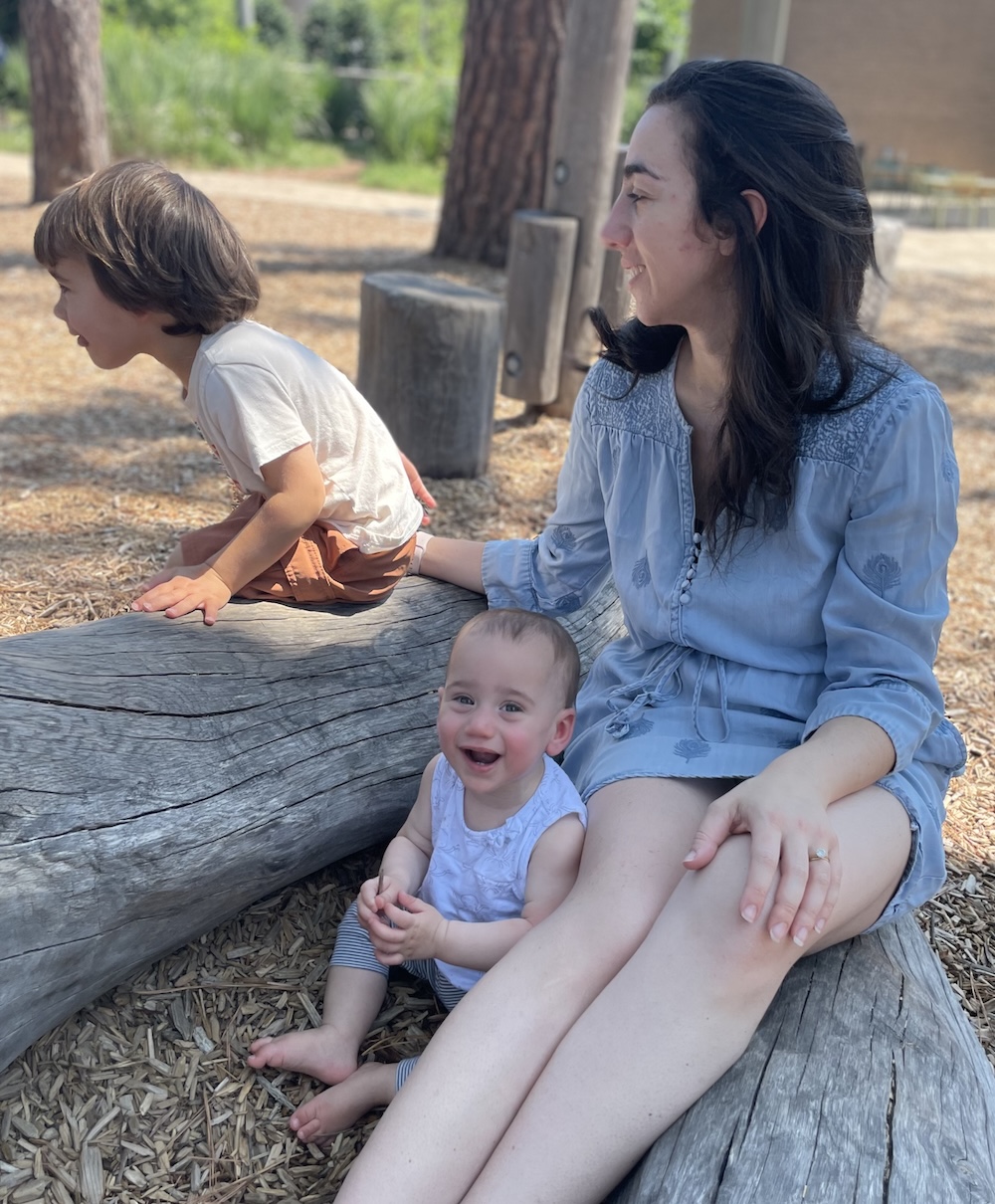
Today, Mayya continues to advocate, raise her children, spend time with her friends and family, and push for more research. She speaks openly about uncertainty, progression, and the experiences that don't always fit neatly into the success stories people want to hear. Because that's part of being a zebra, too. You don't always fit the expected narrative, but you keep moving forward anyway.
She thinks often about the people in her community who are living with ALK-positive lung cancer as something closer to a chronic disease, surviving for a decade or more, and weathering setbacks along the way but still here.
"Those are my heroes," she said. "People who can stumble forward for a decade are my spirit animals. I'll take it. I'm happy just stumbling down the road for another 20 years."
It may not be the path she expected, but she's still moving forward 1 scan, 1 infusion, 1 family trip, and 1 ordinary day at a time.
A lung cancer diagnosis can bring a lot of questions, emotions, and uncertainty. GO2 for Lung Cancer's free HelpLine connects you with trained specialists who can provide support, answer questions, and help you find resources along the way. Whether you're newly diagnosed, in treatment, or navigating survivorship, you don't have to face it alone.
Call us at 1-800-298-2436 or email support@go2.org to learn more.