
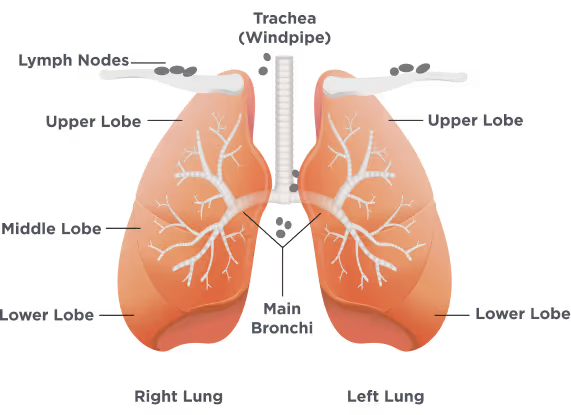
The goal of lung cancer surgery is to remove all tumor tissue while sparing as much healthy lung tissue as possible. In the very early stages of lung cancer, surgery may be the only treatment needed. Most often, surgery is used along with 1 or more other treatment types.
You can receive other treatments before surgery for lung cancer (neoadjuvant therapy) to shrink the tumor or after surgery (adjuvant therapy) to rid the body of any remaining cancer cells. The treatment order depends on the tumor size and how far it has spread.
Your healthcare team will talk to you about whether you need surgery and what type is best for you. The surgery you receive depends on the tumor’s location, size, and stage of lung cancer. Whether or not surgery for lung cancer is a good option for you also depends on your overall health and ability to tolerate the procedure.
Types of lung cancer surgery
Lung cancer surgery names are based on the amount of lung tissue removed. In some cases, surgeons may remove a small piece of the healthy lung along with the tumor, while in other cases, they may remove the entire lung. Many people live full lives with only 1 lung.
Types of lung cancer surgery include:
- Wedge resection: A small wedge-shaped piece of the lung is removed.
- Segmental resection or segmentectomy: A piece of the lung is removed that is larger than in a wedge resection but smaller than a lobectomy.
- Lobectomy: An entire lobe of the lung is removed. This surgery is done when the lung cancer is located away from the center of the chest.
- Bilobectomy: Two lobes of the lung are removed. This surgery can only be done on the right lung that has 3 lobes.
- Pneumonectomy: The entire lung is removed. This surgery is done when the lung cancer is larger and closer to the middle of the chest.
When lung cancer surgery is needed, sometimes lymph nodes around the tumor also need to be removed to look for cancer cells. This is called a lymph node dissection or lymphadenectomy.
How surgery for lung cancer is performed
Lung cancer surgery includes different approaches, each offering unique methods to access and remove cancerous tissue. Common techniques include thoracotomy, video-assisted thoracoscopic surgery (VATS), and robotic-assisted thoracic surgery (RATS).
Thoracotomy
A thoracotomy is when an opening is made in the chest to allow the thoracic surgeon (lung surgeon) to see the lung directly and remove the tumor.
A thoracotomy is done using general anesthesia (medicine to put you to sleep), and a tube is placed into the trachea (windpipe). The lung being operated on is deflated or collapsed, while the other lung is inflated with the help of a device called a ventilator to help you breathe. Once the surgery is completed, the deflated lung is re-inflated and tubes are left in the lung to release excess air and fluid. These tubes are usually removed after 3-5 days.
The first day after surgery may be spent in the intensive care unit of the hospital. Heart rate, blood pressure, and oxygen levels will be monitored. The usual hospital stay after a thoracotomy is 4-6 days.
Video-assisted thoracoscopic surgery (VATS) and robotic-assisted thoracic surgery(RATS)
VATS and RATS are types of minimally invasive surgeries. They are both done using general anesthesia (medicine to put you to sleep), and a tube is placed into the trachea (windpipe). Between 1 and 4 small incisions will be made in the chest to access the lung. Hospital stays and recovery time are typically shorter than with a thoracotomy.
Once the surgery is completed, the incisions are closed. Chest tubes will remain in place for 1-2 days to drain excess air and fluid from the chest.
Although minimally invasive surgery can be used in many cases, not all lung cancer can be removed by these techniques. In addition, they may not be offered everywhere.
VATS
A thoracic surgeon performs VATS using a thoracoscope, which is placed into the chest through a small incision (opening). A thoracoscope is a flexible tube with a camera on the end to see the surface of the lung and the chest wall. Video from inside the chest allows the surgeon to see the lungs and nearby organs close-up. Precision tools are used to remove the tumor(s) through other small incisions.
RATS
A thoracic surgeon performs RATS using 3-D high-definition (3D-HD) video and a robotic arm. This allows surgeons to access tight spaces through small openings in the chest wall. A small 3D-HD video camera is inserted into one of the incisions to give the surgeon a magnified, detailed view of the lung or inside of the chest. Tiny precision tools are used, which the surgeon moves by hand and foot controls. The technology of the camera, the instruments, and the surgeon’s skill allow for the removal of large or hard-to-reach tumors.
Factors that impact lung cancer surgery options
Having surgery as a treatment for lung cancer depends on several factors:
- The type of lung cancer you have
- Where cancer is located in the lung
- If and where cancer has spread
- Your overall health
- Your treatment goals and preferences
Non-small cell lung cancer (NSCLC)
In NSCLC, surgery may be an option in stages 1, 2, and 3 (stages I, II, and III) but is rarely an option in stage 4 (stage IV).
In stages 1, 2, and 3 of NSCLC, surgery is one of the most commonly used forms of treatment. When surgery is performed in stages 1 and 2, it can sometimes be the only treatment needed. For stage 3, surgery is often performed as part of the overall treatment plan, along with other types of therapy.
Small cell lung cancer (SCLC)
Surgery can be part of your treatment plan in some cases of limited-stage SCLC when the tumor is small and hasn’t spread.
Surgery is not a treatment option in extensive-stage SCLC.
Preparing for surgery
You’ll meet with your healthcare learn to learn everything you need to prepare for your surgery. Preparing for lung cancer surgery involves a series of medical tests to assess your overall health. These may include blood and urine tests, a variety of scans, and checking the function of other vital organs.
Before surgery, you will:
- Learn about the surgery and its risks and expected benefits
- Hear about the anesthesia and the drugs given before and after surgery to control pain
- List the medications, vitamins, and herbs you take every day and find out which to stop using before your surgery
- Be advised to exercise, eat a healthy diet, and avoid smoking so you will be strong for your surgery
- Receive an incentive spirometer, a device you can use to help you take deep breaths to keep your lungs healthy
- Plan for your recovery, including a ride home from the hospital, and people to care for you and help with household tasks
- Be asked to sign a consent form agreeing to the surgery
After lung cancer surgery, the tissue removed from the lung is sent to the pathologist, a doctor specializing in diagnosing diseases by studying cells and tissues. They will look at the tumor and the edges around it to see if it was fully removed. If there are no tumor cells at the edges, it means the entire tumor was removed. A member of your healthcare team will share these results with you and discuss how they will be used to guide the next steps in your treatment plan.
Recovery and follow-up care after lung cancer surgery
Planning for a successful surgery is vital to getting the best outcome, but it’s equally important to prepare for recovery after surgery.
You can expect to stay in the hospital anywhere from a few days to a week after lung cancer surgery. People who’ve had thoracotomies are likely to stay in the hospital longer than those who’ve had VATS or RATS.
As you gain strength, you’ll learn breathing exercises to help improve your lung function. Your care team will also encourage you to walk around.
When you’re ready to return home, your care team will provide medicine to help manage any pain and discomfort.
Things to watch out for after lung cancer surgery include:
- Unusual difficulty breathing
- Infections of the surgical site
- A racing heart
- Pain not relieved by medication
- Unexpected bleeding
- Trouble urinating
- Excessive fatigue
Follow your healthcare team’s guidance on when to contact them. You will likely have regular follow-up care and other treatments as a part of your recovery. This may include physical therapy and/or respiratory therapy.
People who have surgery for lung cancer can expect to be back to their pre-surgical activity levels within 3 to 6 months. However, the timeline may be different for those who had their entire lung removed (pneumonectomy).
Questions to ask your healthcare team about lung cancer surgery
Talking with your healthcare team and asking questions ensures you stay informed about your condition and are involved in plans for your treatment. The following sample questions can help get the conversation going with your lung cancer doctor:
- What type of surgery is right for me and why?
- What are the risks of the surgery?
- What are the long-term effects after the surgery?
- How long will I be in the hospital?
- What side effects should I expect?
- Will I feel pain? If so, how will it be controlled?
- When can I get back to my normal activities?
Explore other questions to ask your healthcare team.
Recent advancements in lung cancer
Explore recent advancements in lung cancer, new treatment approvals, research breakthroughs, and more by signing up for GO2’s email communications.

Frequently asked questions
Where can I find more resources and support?
Contact the GO2 HelpLine at 1-800-298-2436 or email support@go2.org to connect with caring and highly trained staff who listen, answer your questions, and provide support. We offer many free programs and educational resources to meet your needs.
How do I know if lung cancer surgery is the best option for me?
Talk with your healthcare team about whether lung cancer surgery is right for you. Be sure to discuss your goals, benefits, and risks of the surgery. For more information about questions to ask your healthcare team, contact GO2’s HelpLine at 1-800-298-2436 or email support@go2.org.
How should I prepare for surgery to treat lung cancer?
Meet with your healthcare team to learn what to expect for your type of surgery and advice during the time leading up to your procedure. Make sure you have the resources and/or the assistance you need to function in your home after surgery. You may also think about connecting with other people who have had lung cancer surgery for support.
What should I expect after lung surgery? Will I need help?
After lung cancer surgery, you’ll be in the hospital for a few days to a week. When you get home, you’ll need help with basic tasks like getting out of bed and getting dressed. You may also need transportation to healthcare appointments for several weeks until you’re well enough to drive again.