
Are You Living or Are You Dying? Melissa's Story
September 9, 2026
In early 2021, Melissa noticed something strange. Whenever she laughed, coughed, or exhaled forcefully, she heard an odd sound coming from her chest. It wasn't painful, it wasn't affecting her breathing, and she was still able to exercise easily, but she also knew it wasn’t normal.
As a veterinarian, Melissa was accustomed to paying attention to subtle changes. At the time, she was also helping lead COVID-19 vaccination efforts, traveling around the country and working long days outdoors in Colorado's unpredictable weather.
When the sound didn't go away, she mentioned it to her doctor. Neither of them was particularly concerned, and they initially wondered if it might be related to cold-weather asthma. An inhaler didn't help, so Melissa returned a few weeks later. To be thorough, her doctor ordered a chest X-ray.
An unexpected diagnosis
The X-ray revealed a mass in Melissa's lung. Even then, lung cancer wasn't high on anyone's list of possibilities. Melissa was young, healthy, and active, and had no traditional risk factors. As a veterinarian, she was more concerned about unusual fungal infections or exposures she might have encountered through her work.
When the biopsy revealed lung cancer, she was stunned.
"I was totally floored," she said. "Of all the things that I thought I was going to get, lung cancer was not on the list."
Despite her medical background, Melissa realized she had carried many of the same assumptions about lung cancer that others do.
"I never even thought that people who didn't smoke could get it," she said.
Further testing revealed that Melissa had EGFR-positive non-small cell lung cancer (NSCLC) that had spread to her brain.
“They were not going to talk me out of it”
Melissa's care team quickly began developing a treatment plan. She underwent stereotactic radiation for 3 small brain metastases and started targeted therapy with Tagrisso (osimertinib). The treatment worked remarkably well, and within months, her tumors had shrunk by more than 50%, and the lymph nodes that had previously shown signs of cancer were no longer visible on scans.
But Melissa couldn't shake 1 thought. As a veterinarian, she knew that, when possible, surgeons often remove the primary tumor. She wanted to know whether surgery could play a role in her own treatment. Her doctors initially hadn't recommended it because her cancer was stage IV (4), and surgery is not a typical treatment for lung cancer at later stages. Still, Melissa continued asking questions.
"I had a really strong gut feeling that I wanted that primary tumor out," she said.
Rather than dismissing her idea, her care team listened. Her local surgeon encouraged her to seek an additional opinion from a thoracic surgeon with more experience treating complex lung cancer cases. Her oncologist supported the idea as well.
After consulting with specialists who supported her as a good candidate for surgery, Melissa underwent surgery in December 2021, just 6 months after her diagnosis. Surgeons removed the upper lobe of her left lung along with 14 lymph nodes.
Looking back, she's grateful that she trusted her instincts and that her doctors were willing to partner with her.
"Honestly, they were not going to talk me out of it," she said. “Even if someone had told me that the surgical outcome would be identical to non-surgical treatment, I still wanted the tumor out of me. Just for the peace of mind.”
Learning to hope again
The first months after diagnosis were some of the hardest of Melissa's life. For a long time, she was convinced she wouldn't survive.
"I was pretty sure I was going to be dead within a year," she said.
Although her doctors were compassionate and honest, they couldn't tell her exactly what the future would look like. There were simply too many unknowns.
Searching for answers, Melissa began reading stories from other people living with lung cancer. For the first time, she saw people talking about surviving for 8 years, 10 years, or even longer.
"It was then I started to have hope," she said.
The stories didn't guarantee anything about her own future, but they helped her realize that she might have one, too. They also showed her that hope and uncertainty could coexist.
Surrounded by support
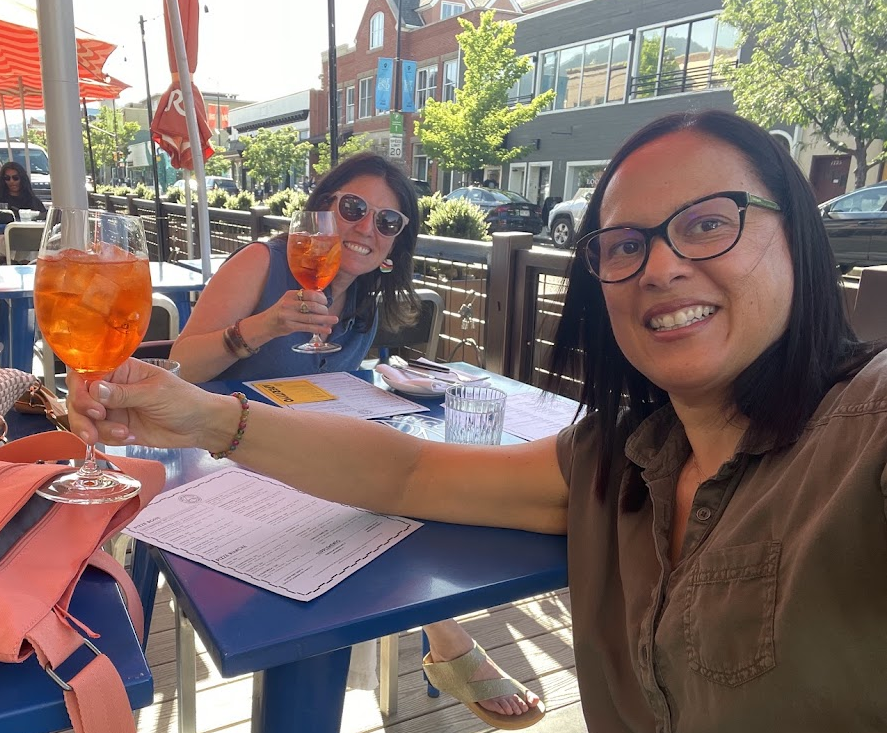
While Melissa was learning to navigate life with lung cancer, she quickly discovered that she didn't have to do it alone. When she was diagnosed, friends from across the country showed up in remarkable ways. One of her closest friends, a fellow veterinarian who lives in Washington state, drove to Colorado and stayed with her for a month. Other friends came for a week at a time, helping with appointments, daily tasks, and the emotional weight of everything she was facing.
Their support arrived when she needed it most. During one visit, Melissa developed a serious bacterial infection and spiked a 104 degree fever. The friend who had just arrived at her house ended up taking her to the emergency room.
Over the years, that support never faded. Earlier this year, Melissa celebrated the 5-year anniversary of her diagnosis with afternoon tea at a hotel in Denver. Nine friends joined her to mark the milestone.
"It was absolutely amazing," she said.
The experience reminded her of something she has learned again and again since her diagnosis: even in the most uncertain moments, she was never facing lung cancer alone.
Are you living or are you dying?
One conversation changed Melissa's perspective more than any other. She had been working with a counselor through her cancer center, struggling with questions about the future. She wondered whether she should buy a house, make long-term plans, and even adopt a new cat, given her diagnosis.
Every decision seemed tangled up in uncertainty. Then, her counselor asked a simple question.
"Are you living or are you dying?"
The question stopped Melissa in her tracks. For months, Melissa had been organizing her life around the possibility that she might die. Her counselor challenged her to consider a different perspective. Today, she wasn't dying. Today, she was alive. For the first time in a long time, she began giving herself permission to plan accordingly.
That realization didn't erase the uncertainty of living with stage IV (4) lung cancer. It simply changed how she chose to respond to it.
Not long afterward, Melissa adopted a young cat. Looking back, she sees that decision as one of the first times she truly started planning for the future again.
"I felt pretty confident that was going to be here to take care of this animal," she said.
Letting go of what she can't control
Over time, Melissa found herself changing in other ways, too. Before cancer, uncertainty often made her anxious. She wanted answers, a plan, and certainty.
After her diagnosis, however, she came to realize that none of those things were actually available to anyone, even those living without cancer.
"I completely accepted that I have no control over any of this," she said. "And I also have no way of predicting anything."
And rather than feeling defeated, Melissa found freedom in that realization. She stopped spending energy on things she couldn't control and became more intentional about where she focused her time and attention. She treasured friendships more deeply and reached out to people more often. She became more grateful for experiences and less concerned about the small frustrations that once occupied her mind.
"I’m so much more clear about how I want to spend my energy now," she said.
Looking ahead
Today, 5 years after her diagnosis, Melissa remains on Tagrisso (osimertinib) and has no evidence of disease. She's also slowly extended the time between scans, going from every 3 months to 4 ½ months to every 6 months. It wasn’t an easy shift.
"Initially, I didn't think I was going to live long enough to have to worry about radiation exposure from the scans," she says. "And now maybe I do."
Her oncologist helped her think through it. Because there's no established playbook for someone in Melissa's exact position, he told her they were “cooking without a recipe.” They talk through decisions together to figure out what they're both comfortable with.
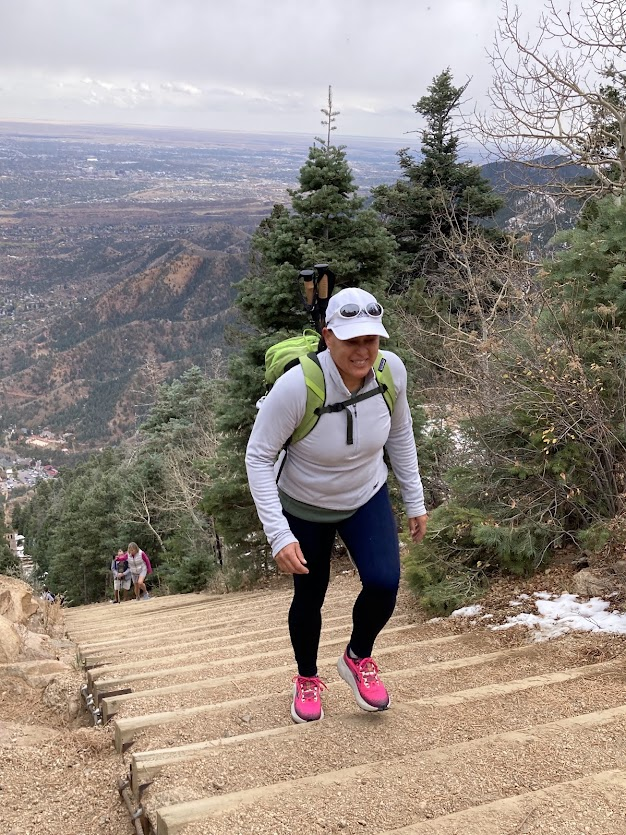
She's also setting ambitious physical goals for herself. A year and a half ago, she decided she wanted to climb the Manitou Incline near Colorado Springs, a grueling hike up what used to be a mining railroad, now more than 1,000 steps rising nearly straight up a mountain. She trained hard for it, but she still wasn't sure she'd make it even halfway.
She made it all the way to the top.
Her next goal is to tackle some of the epic hikes in Glacier National Park that can run up to 14 miles long. She doesn't know yet if she can do it, but she's going to try.
Just 5 years ago, Melissa wasn’t sure she’d live long enough to plan for the future. Today, she's planning trips, setting new goals, deepening friendships, and looking forward to what's next.
She still thinks about the question her counselor asked her.
“Are you living or are you dying?”
These days, Melissa knows her answer.