
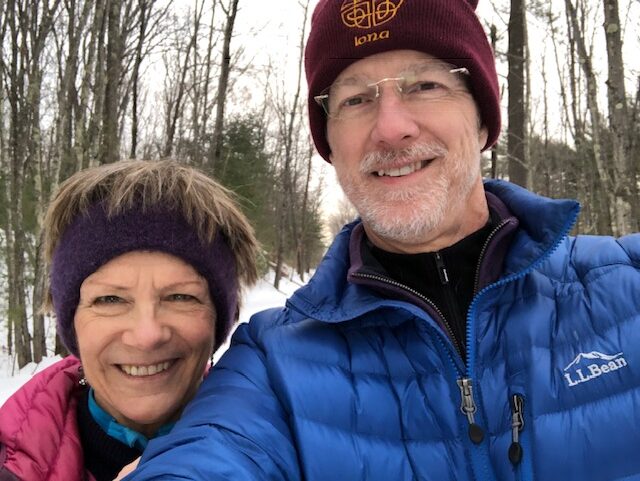
June and Roy Smoot
June & Roy live in Kennebunk, Maine, a place they moved after visiting and vacationing many times throughout their lives. They enjoy barefoot beach walks, snowshoeing, many volunteer activities focused on environmental issues, Indigenous People’s rights, social justice issues, and textile drives organized by June which have kept over 20 tons of textiles and footwear out of landfills. They also enjoy exploring Maine’s forests and mountain areas. June is a retired clinical registered dietician while Roy is a retired banking executive and director. They see a return trip to Switzerland and other excursions in their future. Their favorite toast with an adult beverage is “Ein Sache”, followed by “Uns” — German for “One Thing” and “Us”. Roy is still trying to find where June hid his heart when she stole it. She promises him that it’s in a safe place.
After a history of heart disease, Roy has learned to pay attention to his body, so when he experienced shortness of breath in July 2018, he went to the emergency room. This time, his heart wasn’t his problem. Imaging revealed a large mass in his upper right lung and, with it, a diagnosis that would reshape his years ahead.
Doctors moved quickly. A biopsy confirmed lung cancer, and additional scans showed it had spread to nearby lymph nodes, ruling out surgery. Roy was referred to David Carbone, MD, PhD at The James Comprehensive Cancer Center, where a treatment plan came together quickly.
Roy enrolled in a clinical trial led by Dr. Carbone to explore using immunotherapy in people with stage 3 (III) non-small cell lung cancer (NSCLC). He would receive immunotherapy, then radiation, then chemo, and then immunotherapy again.
The early months were manageable, and Roy didn’t experience any side effects during his initial immunotherapy infusions. Radiation and chemotherapy followed, spaced carefully over many weeks. But toward the end of treatment, a rare and severe reaction to chemotherapy landed Roy in the hospital for 10 days.
This experience forced difficult treatment decisions and required Roy to advocate for himself, something he had learned to do years earlier while caring for his late wife during her illness. Immunotherapy was paused, then ultimately stopped altogether, when Roy developed serious gastrointestinal side effects. By that point, his treatment had already achieved a complete response, and his body could not tolerate continuing.
With treatment complete, Roy entered a new phase: survivorship, including regular monitoring and cautious hope. Follow-up scans initially came every 6 months, then 9, then eventually once a year.
Judy’s story
Roy’s experience with lung cancer was not his first time navigating serious illness. Just a few years earlier, he had walked a parallel path alongside his late wife, Judy.
In November 2015, Judy collapsed in their shower at their home in southeastern Ohio. At the hospital, imaging revealed a large mass in her brain. Judy immediately understood what that meant. Her aunt had died of glioblastoma years earlier, and Judy had been one of her caregivers.
Judy underwent brain surgery the day before Thanksgiving, followed by months of treatment including clinical trials, aggressive chemotherapy, and a 2nd surgery. Despite everything, Roy remembers her determination to keep living fully and authentically, even as options narrowed.
Judy approached her illness with the same intention and creativity that defined her entire life. A spiritual director and artist, she continued creating throughout her treatment, painting, weaving, and writing as a way to make meaning of what she was experiencing. Even after a stroke affected her body’s complete left side (she was left-handed), she adapted, learning to work with her right hand and allowing her art to evolve alongside her changing body.
For Judy, creativity was not a distraction from illness, but a way of engaging with it honestly. She remained deeply connected to people around her and committed to living as fully as possible, even as she faced her reality of a terminal diagnosis.
“She always showed us how to live,” Roy recalls a close friend saying about Judy. “Now she’s showing us how to die.”
Keeping a promise
Judy died in October 2016, after time in hospice that Roy describes as both heartbreaking and deeply meaningful. In his following years, he turned to journaling as a way to survive his abysmal grief.
“For 2 years, I journaled every day,” Roy said. “Sometimes 2 or 3 times a day, whether I was on my porch or in a local pub or a restaurant or the Grand Canyon, you would find me with my journal in hand.”
His writing became a form of self-therapy, a place to hold and process anger, memories, gratitude, and loss all at once. Over time, it also became the foundation for something Judy had asked Roy to do before she died.
“She made me promise to publish her art and her words,” Roy said. “And I said yes, not knowing at the time what that might look like.”
The result was a book built from Judy’s artwork and writing and interwoven with Roy’s journals to become a 3-part story about living well, dying honestly, and finding a way forward. What began as a promise became a project that took 5 years to complete and eventually reached far beyond Roy’s immediate circle. They edited over 950,000 words from him and Judy down to about 85,000 for the book.
Roy is clear that their memoir and award-winning love story was never meant for a narrow audience. It has resonated with people navigating serious illness, caregivers walking alongside loved ones, and healthcare professionals seeking to better understand the lived experience of patients and families.
“I’ve heard from hospice workers, nurses, and social workers who said it helped them better understand the people they care for,” said Roy. Others have told him they read the book not because they were facing illness themselves, but because they wanted to understand who they hoped to be when life becomes difficult for them.
Today, Roy and his new wife, June, give the book, “It All Belongs,” away freely, believing it is meant to be in people’s hands rather than on a warehouse shelf. Copies are available at no cost, with readers asked only to cover shipping. To learn more or request a copy, visit http://itallbelongsbook.com and use code “GO2Cancer” for your free copy.
June
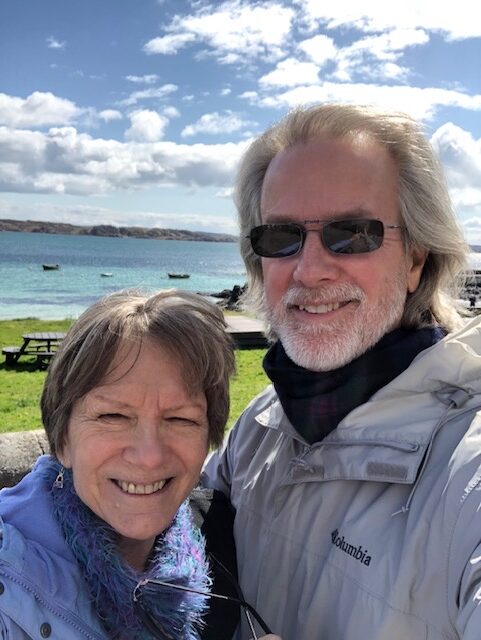 June had been part of Roy’s life long before his lung cancer diagnosis. June met Roy’s late wife Judy through their Ohio church and became close friends. After she died, June and Roy became support for each other, and when Roy learned he had lung cancer, June was one of the first people he called.
“She screamed,” Roy remembered. “And I hated making her feel such pain.”
At that time, June and Roy were just beginning to recognize their growing feelings for each other, but for June, her decision to stay, to support Roy, and eventually to build a life together was instinctive.
“I had this voice that said, ‘I’m not going to let him go through this by himself. He’s already lost his wife of almost 40 years and had more than enough pain from her death,” she said. “I didn’t care where we were going to go or what we had to go through. I was in.”
When Roy proposed, he made sure June understood the reality of his diagnosis. “I said, ‘Do you realize I may not be here in 2 years?” he recalled.
Her answer was immediate. “Well, it’ll be the 2 best years of my life.”
June attended every appointment and every treatment with Roy, and their love deepened even as they navigated all of lung cancer’s difficult challenges together.
They married in Iona, Scotland during Roy’s treatment, after asking his care team whether it was safe to travel. Their answer was yes, and the moment became one of joy woven into a difficult chapter.
What comes next
For more than 5 years after completing treatment, Roy’s scans remained clear. Then, in the fall of 2025 during a routine follow-up appointment with his new oncologist at the Dana-Farber Cancer Institute after a move to Maine, everything shifted again.
“Dr. Sands walked in,” Roy said. “And for the first time he didn’t say, ‘We didn’t find anything.’ Immediately, I knew something was wrong.”
A new tumor had appeared in the same area of his lung that had already been heavily treated. Because of prior radiation and scarring, many treatment options were no longer possible.
“Every option we brought up – radiation, surgery – they just kept getting pushed off the table,” Roy said. “That has been really hard.”
After consultations with multiple specialists, Roy and his care team determined that immunotherapy would likely be their next step. They are currently waiting on additional testing to confirm this as their treatment course, and Roy is eager to get started. While their next steps are currently uncertain, Roy is not without perspective.
“For me to be loved by two such incredible women and to be able to love two incredible women in one lifetime,” he said, “I don’t need a whole lot else. We’ll figure out the rest.”
If you or a loved one are facing similar uncertainty—whether newly diagnosed or navigating what’s next—GO2’s LungMATCH team can help you understand treatment options, including clinical trials, and talk through next steps. Call 1-800-298-2436 or email support@go2.org to connect with a LungMATCH Navigator.
Leave A Comment